A number of readers said to me they loved Auntie Florrie from Encrypted Hearts. I’ll be honest; so did I. I would’ve loved her in my corner when I came out.
Some of you know I was struggling to write a contemporary romance. When I went on a Global Wordsmiths writing course in March, I discussed this with my editor, who encouraged me to write what I wanted to write. I said I had an idea for a short story, featuring Auntie Florrie. The idea… and the manuscript… kept growing, and now she has her own story, a dual timeline second chance romance, which throws us back into 1920s London and comes forward to 1950s Cambridge (UK) and France. One of the key things I wanted was to include Florrie as an older lesbian.
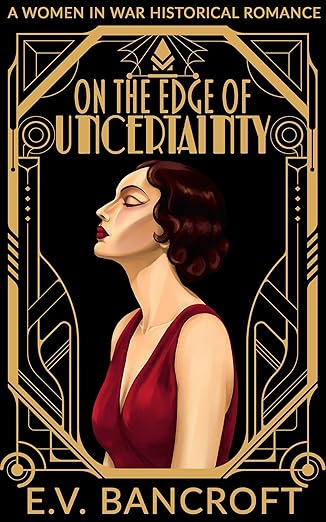
In the sapphic fiction world that’s slowly embracing diversity, older lesbians are still under-represented. I’m not sure if this is because younger readers don’t want to read about the middle-aged or the old, but certainly very few book covers will show older characters on the front. I put my hand up to doing this too. My latest book, On the Edge of Uncertainty, has a portrait of the young Diana in the 1920s, painted in the style of Tamara de Limpicka. Why? Because apparently no-one would pick up a book with a cover of a middle-aged woman.
The stories of younger sapphics are vital, but they’re not the whole picture. Queer women grow up and age. They love, lose, and love again, and drag along a whole truckload of baggage, in the form of family, children, exes and aging bodies. And yet, their stories are still so rarely told.
Post-menopausal Woman
Once a woman passes menopause, she’s often written out of romantic narratives, or there are “comic” references to hot flushes, but nothing else. Society ignores older women or writes them off as being crones. But love doesn’t disappear with age, nor wisdom. Desire doesn’t wither either. Older lesbian representation reminds us that connection, self-discovery, and passion are lifelong experiences. And there are advantages to growing older, the chief being not giving a damn what people think, or feeling you have to be seen somewhere, or do something. For me, for the first time in my life, I’m now actually doing exactly what I want to do: writing.
Older Women carry Queer History
Many older lesbians lived through times when queerness had to be hidden. In the UK, this was characterised by Section 28, when being out could cost you your job, your family, or your safety. Most of my contemporaries have stories of being closeted at work or not daring to come out until later in life. To this day, my father refuses to talk about my sexuality, and still refers to my ex as “that woman”, who he blames for corrupting his daughter. A lot of the freedom and acceptance we have today is because lesbians in the past refused to be silent and demanded to live authentically.
Older Representation
Representation in books shapes how we see ourselves and how society sees us. Without stories of older lesbians, we reinforce the idea that queer life stops being visible after a certain age. But when readers encounter women in their fifties, sixties, or beyond who are falling in love, living and thriving, it changes the narrative. It tells readers: You are still here. You still matter.
Connecting Generations
When I wrote Warm Pearls and Paper Cranes, which shows two women from their teens to their nineties, I wasn’t sure the older women would appeal to anyone, yet I’ve had a number of readers who’ve said how much they enjoyed seeing how it’s possible to live a full, authentic queer life, and how they can relate to some of the entrenched misogyny along the way. Others have said how they’ve loved being able to celebrate old queer women having a happy ever after.
Stories are how we make sense of who we are and who we can become. When older lesbians are missing from those stories, a vital part of our shared humanity is lost. We need more books that celebrate our heartbreaks, our complex lives, and our courage to love again.
Because representation isn’t just about being seen. It’s about being remembered. And it’s time older lesbians took our place in the stories we tell about love, life, and everything in between.
 EV Bancroft
Leave a comment