Why We Need Stories about Older Lesbians.

A number of readers said to me they loved Auntie Florrie from Encrypted Hearts. I’ll be honest; so did I. I would’ve loved her in my corner when I came out.

Some of you know I was struggling to write a contemporary romance. When I went on a Global Wordsmiths writing course in March, I discussed this with my editor, who encouraged me to write what I wanted to write. I said I had an idea for a short story, featuring Auntie Florrie. The idea… and the manuscript… kept growing, and now she has her own story, a dual timeline second chance romance, which throws us back into 1920s London and comes forward to 1950s Cambridge (UK) and France. One of the key things I wanted was to include Florrie as an older lesbian.

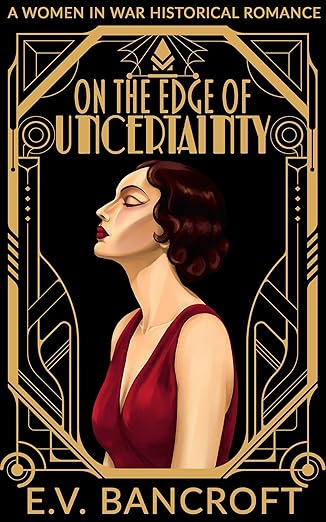
In the sapphic fiction world that’s slowly embracing diversity, older lesbians are still under-represented. I’m not sure if this is because younger readers don’t want to read about the middle-aged or the old, but certainly very few book covers will show older characters on the front. I put my hand up to doing this too. My latest book, On the Edge of Uncertainty, has a portrait of the young Diana in the 1920s, painted in the style of Tamara de Limpicka. Why? Because apparently no-one would pick up a book with a cover of a middle-aged woman.

The stories of younger sapphics are vital, but they’re not the whole picture. Queer women grow up and age. They love, lose, and love again, and drag along a whole truckload of baggage, in the form of family, children, exes and aging bodies. And yet, their stories are still so rarely told.

Post-menopausal Woman

Once a woman passes menopause, she’s often written out of romantic narratives, or there are “comic” references to hot flushes, but nothing else. Society ignores older women or writes them off as being crones. But love doesn’t disappear with age, nor wisdom. Desire doesn’t wither either. Older lesbian representation reminds us that connection, self-discovery, and passion are lifelong experiences. And there are advantages to growing older, the chief being not giving a damn what people think, or feeling you have to be seen somewhere, or do something. For me, for the first time in my life, I’m now actually doing exactly what I want to do: writing.

Older Women carry Queer History

Many older lesbians lived through times when queerness had to be hidden. In the UK, this was characterised by Section 28, when being out could cost you your job, your family, or your safety. Most of my contemporaries have stories of being closeted at work or not daring to come out until later in life. To this day, my father refuses to talk about my sexuality, and still refers to my ex as “that woman”, who he blames for corrupting his daughter. A lot of the freedom and acceptance we have today is because lesbians in the past refused to be silent and demanded to live authentically.

Older Representation

Representation in books shapes how we see ourselves and how society sees us. Without stories of older lesbians, we reinforce the idea that queer life stops being visible after a certain age. But when readers encounter women in their fifties, sixties, or beyond who are falling in love, living and thriving, it changes the narrative. It tells readers: You are still here. You still matter.

Connecting Generations

When I wrote Warm Pearls and Paper Cranes, which shows two women from their teens to their nineties, I wasn’t sure the older women would appeal to anyone, yet I’ve had a number of readers who’ve said how much they enjoyed seeing how it’s possible to live a full, authentic queer life, and how they can relate to some of the entrenched misogyny along the way. Others have said how they’ve loved being able to celebrate old queer women having a happy ever after.

Stories are how we make sense of who we are and who we can become. When older lesbians are missing from those stories, a vital part of our shared humanity is lost. We need more books that celebrate our heartbreaks, our complex lives, and our courage to love again.

Because representation isn’t just about being seen. It’s about being remembered. And it’s time older lesbians took our place in the stories we tell about love, life, and everything in between.

Who Remembers the Forgotten Pilots?

Photo of Joan Hughes by a Stirling Bomber she piloted in WW2

I’m really looking forward to you meeting Odette and Beryl when Virgin Flight is released into the world on 1st December. It’s available to pre-order now on mybook.to/VirginFlight.  It was such a joy to write and I was reluctant to let the characters go.  In fact, I still miss them.

The early reviews coming through are phenomenal, and I’m delighted that readers are enjoying their story as much as I enjoyed living it and retelling it.  For those of you who don’t read historical fiction, maybe you can think of the book as a slow burn romance with adventures in aeroplanes set a number of years ago :0)?

History gives us an insight into the past, shows lessons we may learn and gives us context for current events.  It doesn’t have to be depressing either. I’m fascinated by the WW2 period, not because of the war, but because women were finally given opportunities that wouldn’t otherwise have been available to them. And they rose to the challenge.

We also need stories about people overcoming adversity and thriving despite that. The themes of love and loss are universal and endure throughout time. So yes, Virgin Flight is about women who fly during WW2, delivering the planes needed by the RAF. An Air Transport Auxiliary (ATA) Pilot could be flying a damaged bomber one flight and a pristine Spitfire from the factory the next, and they could fly five or six deliveries a day from sun up to half an hour before dark, so they were long days.

I’ve nothing but admiration for the women pilots, many of whom hadn’t flown before the war, and some of whom never flew again afterwards. Sadly, the misogyny returned once the war was over. The women who impressed me the most were those who went on and found ways to continue flying despite the prejudice against taking on female pilots by the big airlines.  ATA pilots like Diana Barnato Walker, who was the first British woman to break the sound barrier, Joan Hughes, who became a stunt pilot for films and Mary Ellis who later became Managing Director of Sandown airport were exceptional in that they continued to fly after the war.

As part of my research, I visited the Air Transport Auxiliary Museum, in Maidenhead, near the Head Quarters aerodrome of White Waltham. I thoroughly enjoyed seeing artefacts and reading extra details that you can’t get in books. And did I need to have a go in the Spitfire simulator? Of course I did! When I was younger (and had more money!) I used to fly light aircraft and microlights, but the speed with which the “spitfire” covered the ground, and the extent of the poor visibility surprised me. My esteem for the pilots went up threefold.

For this remembrance weekend (Veteran’s Day in the US) I honour all those courageous women who risked their lives every time they flew, relying solely on a map and compass, without the aid of  flying instruments or radios.  They frequently faced poor weather as they undertook their assigned deliveries.  The ATA were sometimes described as the forgotten pilots as they didn’t get the media attention given to the RAF pilots. They are not forgotten.

What’s the Inspiration For a Story?

Recently, I’ve been delighted to be invited to speak and read from my books and answer questions. One question that comes up quite regularly is, “Where I get the inspiration for my stories, is it a location, or a character?”

I know some people hear (or see) a character and how they behave in the world, but for me it is a situation, a challenge or conflict and I start thinking, “what if?”

My debut novel, Warm Pearls and Paper Cranes was prompted because one of my aunts instructed that she be buried with her housemate and friend rather than in the family plot. They weren’t lesbians, but I thought what if? What if two women had hidden their relationship from everyone for years, what would happen if they were put into different care homes? What if they were estranged from their relatives because they hadn’t been honest about who they were?

This book is also close to my heart as I became more distant from my aunt as she was very religious and didn’t approve of my lifestyle, and had always planned to reconnect when I had more time. So, I guess it was a way of trying to seek resolution, or absolution, for not getting to see her before she died. At least in Warm Pearls there is a happy ending and Maud is reconciled to her niece, Hannah.

Of Light and Love was inspired by an artist friend who was losing her eyesight and couldn’t paint any more. How gutting it must be to no longer do what you had devoted your life to, what gave you your sense of purpose and identity. What if you couldn’t paint anymore? Because the novel was a romance it seemed appropriate Caro had lost her muse. And because everyone loves a grumpy and sunshine, she needed a counterpoint to her grumpiness in the form of Laura. Of course, Laura also has a depth to her and her sunshine is often an act to cover up her hurt.

My newest release, Green for Love is an enemies-to-lovers story featuring an eco-warrior versus an oil executive. They meet in a high-end women’s only club and really click emotionally. Then they discover who the other is, and it all goes wrong with a clash of their different values and approach to life.

What was the inspiration? I was dating a woman and it seemed to be going well. We’d got to the third date and, being curious, I asked if she thought that her eco activism was effective, as I was genuinely interested. It was clearly the wrong thing to say. I had intended it as a conversation opener, not the fizzling end of what could be. Needless to say, we didn’t see each other again.

They say you should weave your life disappointments into your stories, so that became the nub of the conflict. Maybe there was a hangover though, as it took time and a rethink of one of the characters, because I didn’t like her in the first draft. Some authors can write someone they don’t like. I can’t.

It took a rewrite, after discussions with my editor, to really get under Lia’s skin, to hear her voice and understand where she was coming from, to really engage with her softer side. I think the story is so much stronger because of that, and certainly the early reviews bear that out. It’s available now on Amazon and Kindle Unlimited so you can check it out.

Has a particular incident spurred you to write, or wonder, “what if?”

Is there still a need for Sapphic Fiction?

In my book group, it was my turn to choose the book this time. Naturally I chose an independent sapphic book, with the intention of trying to encourage my fellow readers to dip their toes into the waters of sapphic fiction. We had a discussion of the last lesfic book they had read, Jane Rule’s Desert of the Heart, which is probably as old as I am!

Sadly, I don’t think I converted anyone.  They said the book I chose was light and predictable.  It was a romance and by definition a romance should have a happy ending. As a group they’re used to reading literary fiction and they expected twists and turns and depth, so I guess they’re not used to the tropes and expectations of the genre. They would expect a mystery to solve the mystery at the end, surely?

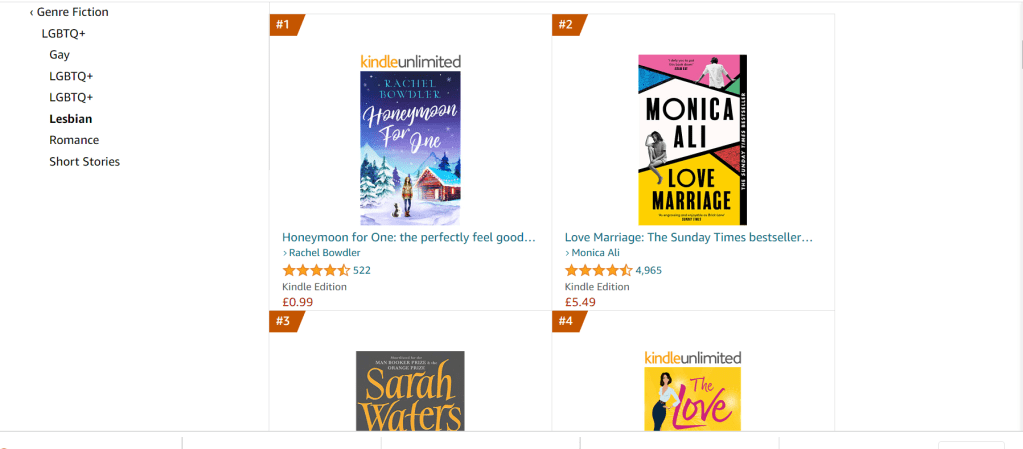
Someone posed the question about whether there is a need for independent sapphic fiction any more. By inference there are so many sapphic themed books in the mainstream now it’s not necessary to have a separate genre. Certainly judging by the number of mainstream novels in the Amazon top 100 lesbian fiction bestsellers, they do seem to be pushing out the independent sapphic books.

I think it’s great that people can go into a bookshop and pick up a sapphic themed book, whether that’s from a mainstream publisher or an independent publisher, but the independent publishers will never get full access to the main shelves because those are tied up with the top publishers ( in the same way that the big music publishers gain access to the radio air lists).

So do we need an independent sapphic genre with publishing done by independent authors or small publishing houses? Yes we do, in my opinion, for the following reasons:

  1. Mainstream sapphic literature is written primarily by mainly white women of a certain age from the UK or USA. Whereas independent Sapphic fiction gives a voice and resonance to  the diversity of cultures and different identities within the term sapphic.
  2. Mainstream sapphic fiction is produced by large publishing houses who are primarily concerned with the profits they will make, therefore will tend towards what will appeal to the mass market (as happens in the movie business and the music business). Independent authors can and should include the range of diverse opinions and stories and take bigger risks in what they write and publish.
  3. Most of the mainstream books in the Amazon top 100 lesbian books are certainly less predictable than the sapphic fiction, but they are also much more likely to have an ambiguous or unhappy ending. As a community we need to have books dealing with life’s struggles with happy endings and believe we can walk off into the sunset holding hands.

If mainstream sapphic fiction truly embraced diversity and life affirming novels then maybe we wouldn’t need a separate shelf for sapphic fiction, but sadly people seem to be becoming entrenched in their reading (and watching and voting) habits rather than being open to discussing a different viewpoint. So I shall continue to read the literary fiction and sapphic fiction, both of which I love, and next time it’s my turn to choose a book I shall select another independent sapphic book for them to read and appraise. Maybe one day they will pick up another sapphic book and enjoy it. I can hope.